The Snowbird's Guide to Leaving Your Solar (and AC) for the Summer
Leaving Southwest Florida for the summer? Your empty house still has a job: staying dry. Here's how to set your AC, use your solar and monitoring, and decide whether a battery earns its keep while you're up north.
Last verified:
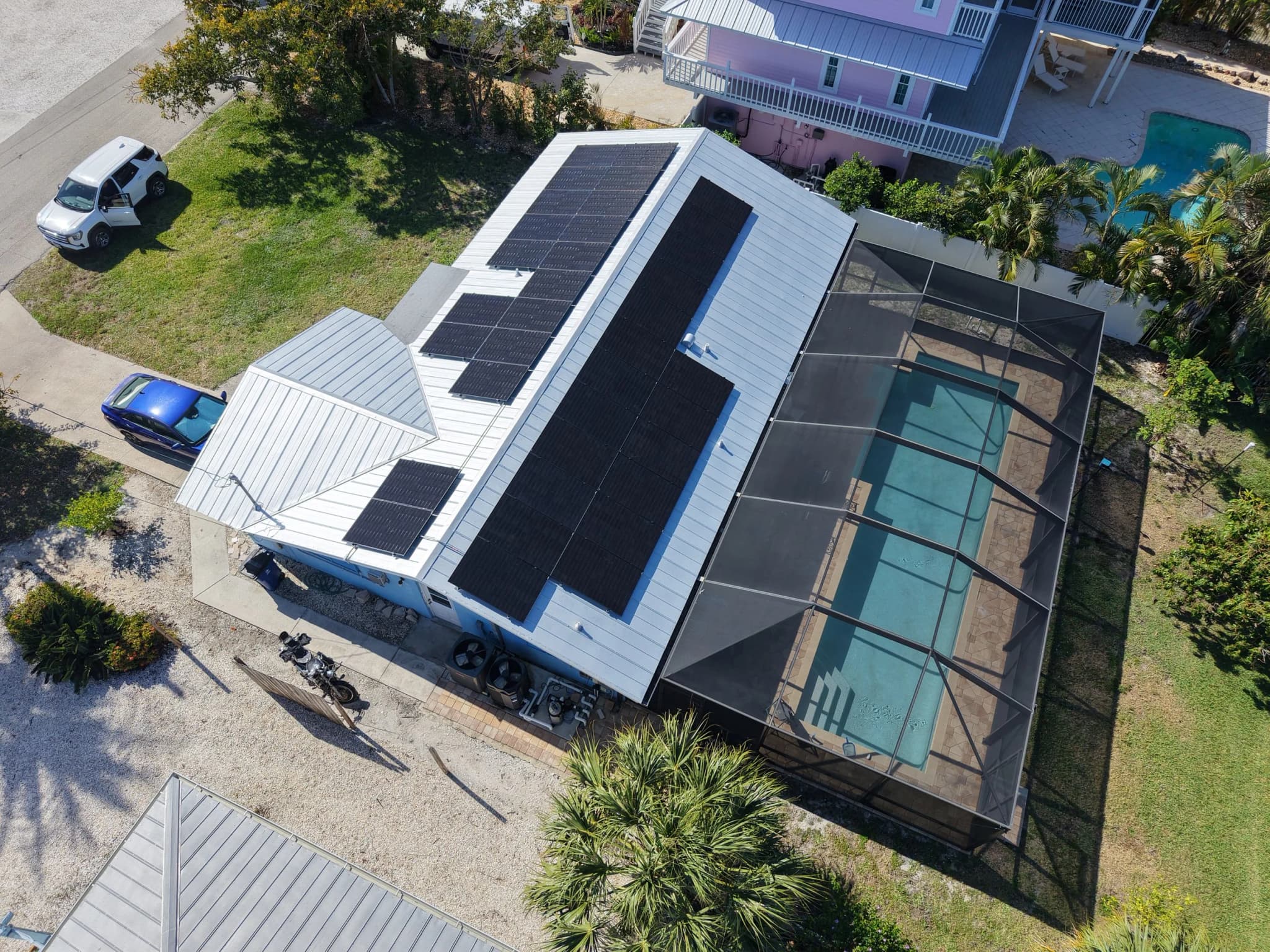
Short answer: Turning the AC fully off to save money is the classic mistake — Florida humidity turns an empty house into a mold experiment. The better move is to keep the house cooled and dehumidified at a moderate 'away' setpoint, use remote monitoring so you can check both the AC and the solar from up north, and consider whether a battery is worth it to ride out summer storm outages while you're gone. Solar can offset a chunk of that summer cooling cost, but the savings are a range, not a promise.
Every summer, a familiar debate plays out in half-empty SWFL neighborhoods: do you switch the AC off to avoid a brutal cooling bill, or leave it on and eat the cost? Flip it fully off and you can come back in October to warped floors, musty closets, and a science project growing in the guest bath. Leave it cranked and the summer bill is its own kind of pain. The answer is neither extreme.
Set the AC to protect the house, not to freeze it
The goal while you're away is humidity control, not comfort for nobody. Most Florida guidance lands on keeping the thermostat at a moderate 'away' setpoint — warm enough to save energy, cool enough that the AC still cycles and pulls moisture out of the air. Many owners pair that with a smart thermostat set to hold humidity in check, or a dedicated dehumidifier draining to a safe spot. The exact setpoint depends on your home, so treat any single number you see online as a starting point, not gospel.
An empty Florida house isn't 'off' — it's fighting humidity every single day. The job you're leaving it is simple: stay dry. Everything else is secondary.
Where solar fits
Summer is peak sun in SWFL, which is also peak cooling season — so a solar system is producing hard exactly when your away-mode AC is drawing power. For a home that keeps the AC ticking all summer, solar can offset a meaningful chunk of that cost. How much depends on your roof, your system size, your utility's net-metering rules, and how low you set the thermostat — which is why we model your actual usage rather than quote a billboard number. If you're on a co-op like LCEC versus FPL, the credit math differs too, and that changes how a summer-away home pencils out.
Monitor it from the porch up north
The whole point of leaving is not thinking about the house — but ten seconds of glancing at an app beats a September surprise. Set up remote monitoring for both systems before you go: your thermostat app so you can confirm the AC is holding temperature and humidity, and your solar monitoring app so you can catch it if production flatlines. A system that trips offline in June and sits dead until you fly back in November is a whole summer of lost production. (See our two-minute self-check.)
Should you add a battery?
Here's the honest part. Summer is storm season, and an outage while you're 1,500 miles away means your AC stops and the humidity moves in. A battery paired with a backup-capable system can keep essential circuits — and, with enough capacity, some cooling or a dehumidifier — running through an outage, and you can watch it happen from your phone. But be realistic: air conditioning is a heavy load, batteries are finite, and a multi-day outage under storm clouds tests any system. A battery is a strong tool for the summer-away problem, not a magic guarantee. We'll size it to what you actually need to protect, and tell you if it doesn't pencil out.
One more note worth saying plainly: standard grid-tied solar with no battery shuts off during an outage as a safety feature, so 'I have solar, the house is fine' isn't true unless you've got storage. If riding out summer outages is the goal, the battery is the part that does it.
Questions worth asking
- What away-mode setpoint and humidity target make sense for my specific home?
- Can I monitor both my AC and my solar remotely before I leave?
- If I want outage protection while I'm gone, which circuits should the battery cover?
- How does my utility's net metering affect summer-away savings?
• When this might not make sense
We'd rather lose a sale than put you in the wrong solution. Reasons we might tell you to wait or pass:
- —You plan to shut the AC completely off to save money — in Florida that risks mold and moisture damage that dwarfs the savings
- —You want a battery to run whole-home AC for days on end unattended — that's more capacity than most setups realistically deliver
- —You won't set up remote monitoring, in which case a summer failure could go unnoticed for months
Sources
- Thermostats and home cooling efficiency guidance — U.S. Department of EnergySecondary
- Solar-plus-storage basics and grid-interaction research — National Renewable Energy LaboratorySecondary
- LCEC Net Metering — LCEC (2026)Primary
Make 'away' mean protected, not gambled.
We'll plan a summer-away setup — solar, monitoring, and a right-sized battery for outage protection — so your empty house stays dry and you stay relaxed up north.